Reducing Cultivation Cost of Algae
Using wastewater, flue gas, and in-reactor lights to cut algae growing costs
TLDR:
-
Decreased Cost of Algae from $5/kg and to $2.62/kg
-
Projected to have $135,630 in net profit from one 5,000 liter reactor per year (not including transportation cost).
There are 3 main cost categories in algae farming: Cultivation, Dewatering, and Drying.
Cultivation is the process of growing algae. Dewatering is the process of separating water and algae cells. Drying is the process of taking the water-separated algae and increasing the density (measured in grams of biomass per liter or g/l). This week I focused on cultivation.
There are 3 main components to consider in cultivation: Nutrients, CO2, and Lights.
Nutrients
Algae need nitrogen and phosphorus to grow. Those nutrients are abundant in wastewater. As algae use nitrogen and phosphorus, they also clean wastewater. The US government pays around $5/gallon to clean their wastewater. You can clean wastewater for $4/gallon with algae.
Below are excerpts from a review paper showing how effective algae is for wastewater treatment.
“The algal pond could remove pollutants, especially N and P, more efficiently compared to the conventional activated sewage process (Zhou et al., 2014). C. Vulgaris, achieved a nitrogen reduction percentage of 100% in wastewater, under high light supply conditions (Gonçalves et al., 2014).”
“The study showed 80% TN (total nitrogen) removal efficiency. This coincides with a study reported by Iasimone et al. (2018). Affected by C. Vulgaris, 94% TP (total phosphorus) removal efficiency was recorded at the end of the cultivation period.”
Algae can also work with almost any type of wastewater. Algae can produce biomass in wastewater such as urban wastewater (Tercero et al., 2014), domestic wastewater (Aziz and Ng, 1992), textile wastewater (Chu et al., 2009), piggery wastewater (Ji et al., 2012), membrane-treated distillery wastewater (MTDW), and Biogas slurry.
My current understanding is algae hits government regulations for wastewater treatment. I am using the proxy of algae wastewater companies that work with governments to assume that algae clean the water up to the standard. I would validate through testing.
Adding glucose increases yield by 30%
CO2
From different conversations, everyone in the algae industry pays for CO2 to help grow the algae. My current hypothesis to decrease cost is to get flue gas (about 10-15% CO2) from manufacturing facilities. In Canada, there is a $50/ton carbon tax. You would take the CO2 and capture it using algae. Money made from carbon capture can be split 50/50 between you and the manufacturer.
From looking at research done by the University of Kentucky, they have been able to connect tubes from a manufacturing facility to a CO2 tank. The tank is then connected to the photobioreactor. This leads me to believe that connecting tubes to the manufacturing facility to extract CO2 is possible.
Lighting
With photobioreactors, there are tubes and there are lights.
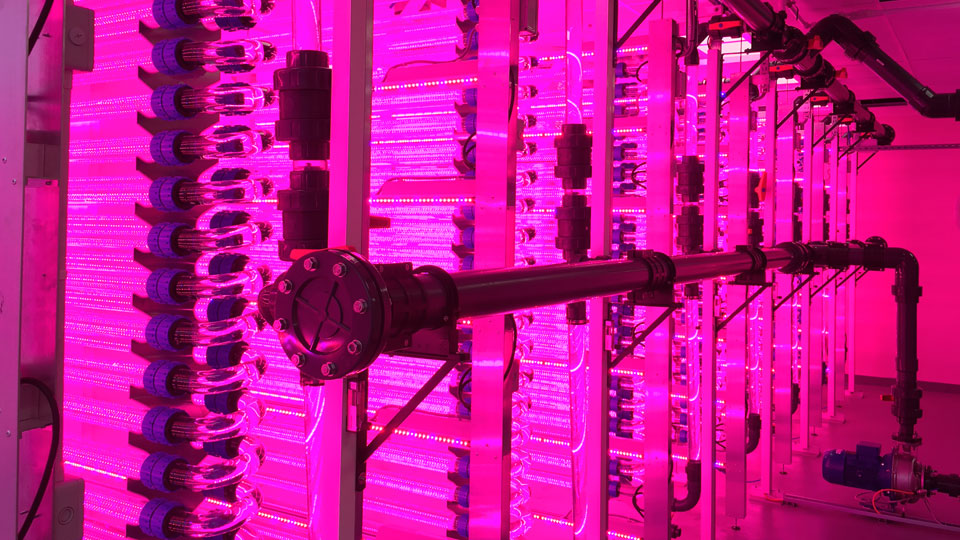
The lights can be found outside of the reactor. When scaling your algae operation (with small tubes), you will lose up to 30% of your yield inside of the valves — which control the flow of CO2. With one large reactor, you only lose about 2% from valves.
With a large reactor, the material acts as a barrier to light penetration. This results in light not reaching the middle of your reactor, giving suboptimal lighting for your algae.
If you put your light inside the reactor, you can increase your photon input to the algae by 10x, meaning you can get the same amount of algae to yield with 10x less power for LEDs. To further improve light absorption, you can genetically modify the algae to increase their light absorption efficiency by 20%, reducing that amount of light you need by 20% after the 10x decrease. For example, a study on tomato plants grown under LED lighting found that supplementing with IR light at a wavelength of 730 nm increased plant yield by up to 25% compared to plants grown under visible light alone. When you add glucose you can increase yield by another 20-30%. When you add fungi, you can increase yield another 30%.
Steam Cleaning
After growing algae and removing it from the reactor you can find extra clumps of algae. If you keep them there you will contaminate your second batch. To solve this problem people use steam cleaning. The problem is you need to have over 100 degrees heat input into your system. To remove the energy requirement we will use UV radiation to clean up the tank and remove contamination.
Cooling
With light inside the reactors, some of the energy from LEDs goes is lost in the form of thermal energy. Increased heat will create suboptimal growth for algae. People in the industry use cooling. After talking with experts it turns out the heat increase was only 5-10 degrees which has negligible effects on algae growth. So we can remove the cost all together.
Labor
Manual for algae harvesting and cleaning represents about 20% of cultivation costs. Some companies like Industrial Plankton have made automated harvesting and cleaning to require 90% less labor, saving money.
Overall Costs (With Improvements Mentioned Above)
The cost of algae farming before making any improvement is $5/kg. 50% of the cost goes into cultivation. If you were to break down the cost of photobioreactors, it would (approximately) look like this.
-
Nutrients (10%) — $0.25
-
Cost is eliminated because algae have sufficient nutrients from wastewater, which does not have a cost.
-
New cost = $0
-
-
CO2 (5%) — $0.125
-
Cost is eliminated be from getting flue gas from manufacturing facilities.
-
New cost = $0
-
-
Lighting from LEDs (35%) — $0.875
-
You put the LEDs inside the reactor to decrease the energy requirement by 10x.
-
You can genetically modify the algae to increase light absorption reducing your energy costs by 20%
-
Cost: $0.875/10 (reduction for light inside reactor) = $0.0875 * 0.8 (reduction from genetic modification) = $0.07
-
-
Cooling (20%) — $0.5
-
We don’t need the cooling function because the extra heat in the system is negligible.
-
Cost cost: $0
-
-
Steam Cleaning (10%) — $0.25
-
UV radiation makes the energy cost negligible.
-
Cost: 0.0
-
-
Labor (20%) — $0.5
-
Labor cost is reduced by 90% through automation of the harvesting and cleaning of reactors.
-
Cost: 0.5 * 0.1 (to represent 90% reduction) = $0.05
-
Overall: 0 (nutrients) + 0 (CO2) + $0.07 (lights) + $0.0 (cooling) + 0.0 (steam cleaning) + $0.05 (labor) = $0.12/kg. Cultivation cost went from $2.5/kg to $0.12/kg. The new overall cost is went from $5/kg to $2.62/kg.
From talking to employees at the company Brevel I found they got to $1.25 for cultivation. Some of the improvements I mentioned above were directly from them. The difference between us is algae is genetically modified to absorb more light. The cost of nutrients was removed from using wastewater. The CO2 cost was removed from using flue gas from manufacturing facilities. A cold thermal battery (and eventually a heat recovery mechanism) to reduce the cost of cooling.
Brevel currently has a (collective) cost of $1.25 for both dewatering and drying. Even though they are using status quo methods they have a 2x cheaper cost. From a few other calls, it was mentioned that cost of dewatering and drying is cheaper in indoor algae operations. If we were to use Bevel’s cost of dewatering and drying (which I will improve in the future) plus the new cultivation cost of $0.77, you get about $2/kg which is a significant improvement from the original $5/kg.
For economics, there are a couple of ways you can make money using algae. Using carbon taxes or carbon credits, cleaning wastewater, and producing biofuel.