Turning Algae Into A Value Add Product
Turning dried algae into biochar, bio-oil, and diesel, powered by heat stored in sand
What is the Best Process to Create a Value Add Product From Algae?
After algae is dried, my main priority is to produce biochar. There are 3 main processes to produce biochar: pyrolysis, carbonization, and torrefaction.
All of the processes are essentially the same, you heat your biomass to a couple hundred degrees of heat with a limited presence of oxygen, the main difference is the product motivation behind them.
For example, the primary motivation of pyrolysis (called fast pyrolysis) is to maximize its liquid production while minimizing the char yield. The objective of carbonization (called slow pyrolysis), on the other hand, is to maximize fixed carbon and minimize hydrocarbon content of the solid product. The objective for torrefaction is to maximize energy and mass yields with reduction in oxygen to carbon (O/C) and hydrogen to carbon (H/C) ratios.
Seems that our 2 main options are carbonization and torrefaction. The key difference between the two is temperature. Torrefaction works between 200-300°C, carbonization works between 300-500°C. As a result of the different temperatures, carbonization drives away most of the volatile organic compounds (VOCs), but torrefaction retains most of it.
You don’t want VOCs in your biochar because VOCs vaporize into the atmosphere at room temperature. Since VOCs vaporize at room temperature — around 68 to 77°F (20 to 25°C) and ideal soil temperatures for planting most plants are between 65 to 75 degrees F. (18–24°C.). This suggests that VOC content will evaporate from the soil. Since biochar stores water, when the VOCs vaporize, the same will happen with water. Water includes all of the nutrients that are needed for a plant to grow. When the water evaporates you also lose nutrients. VOCs have been shown to cause detrimental effects on leaves, flowering, seed production, protein content, plant metabolism.
Based on this knowledge, it seems that carbonization (or slow pyrolysis) is the best for maximizing biochar yield and removing VOCs. The output of carbonization us 30% bio-oil, 35% synthetic gas, and 35% biochar.
What Are Economics of Products From Pyrolysis?
If were to have 1000kg (1 ton) of algae biomass we would get 300kg of bio-oil, 350kg of synthetic gas (syngas), 350kg of biochar.
Bio-oil can be turned into hydrogen through a steam reforming reaction using a fixed bed reactor. The hydrogen can replace natural gas for applications like producing fertilizers The first application I would use would be heating oils. In the U.S. about 60% of energy comes in the from heat, requiring heat oil. Heating oil trades at a $3/gallon about ($0.79 liter). 1 liter = 1kg. This means 300kg of oil would sell for $238.
For syngas, the primary application would be diseal fuel (which would be used for cars). You can’t use syngas as the direct fuel because it has high self-ignition temperature (typically above 500°C) and as a result, it cannot be ignited by compression ignition in a diesel engine, making it not useful for a car. You would need to convert syngas to diseal fuel using the Fischer-Tropsch process (working at 150–300 °C). The conversion efficiency from syngas to diseal is between 60%-90%. For this calculation I assumed 75% efficiency. 350kg of syngas becomes 262.5kg of diseal. Diseal costs about $1.5/liter. The 262.5kg of diseal would sell for $403.
Side note: FT naphtha (C5–C9), FT middle distillates (C10–C20), and FT wax (>C20). FT middle distillates (diesel and jet fuels) are the premium fuel components that contain virtually no sulphur and have a high cetane number (a measure of the ignition quality of diesel fuel; the higher the number, the easier it is to start a standard direct-injection diesel engine).
For biochar, the comparable selling cost is fertilizer. Considering the benefits mentioned earlier, biochar acts a fertilizer and a soil enhancer. The 8 major fertilizers (UREA, MAP, DAP, POTASH, etc.) cost anywhere between $596/ton to $1431/ton. For this calculation will price biochar at $1000/ton, but would need to validate with farmers how much they are willing to pay for it. The 350kg of biochar would cost $350.
When you combine the 3 products of bio-oil, syngas, and biochar you would make $991 ($238+ $403 + $350) per 1000kg (1 ton) of algae biomass.
Note: I would need to talk to people in the industry to validate that this thinking is correct.
How Would You Decrease Opex of Pyrolysis?
What you might notice is I conveniently didn’t mention the operational cost of pyrolysis. You would need a significant amount of energy to be able to fulfil 300-500°C everyday year round. Since I want to avoid emissions from the process I would need some form of renewable energy and energy storage. For this case I would use solar panels for energy generation and sand for energy storage.
The idea for using sand might seem to have come out of nowhere. I was recently watching an interview with a Finnish company called Polar Night Energy who are using sand to store heat for months. Most energy storage is focused on the hours to days time scale. The reason this company wanted to store heat for months is Finland did not have any sun for months during the winter time.
After watching that interview I thought what about if I used the same concept for a pyrolysis machine.
The advantage of sand is it costs between $30‒$50/ton (very cheap). From my understanding most (if not all of the opex) for pyrolysis comes in the form heat. With sand storage it would give 0 carbon heat instead of using natural gas.
How Does Sand Thermal Storage Work?
At high level how here is how sand can be used for energy storage. You use surplus energy from renewable energy to heat sand at 600°C (temperature it can hold for months). Particles are fed through electric resistive heaters which converts electricity to heat at a 100% efficiency. The heated particles are then gravity-fed into insulated concrete silos for thermal energy storage.
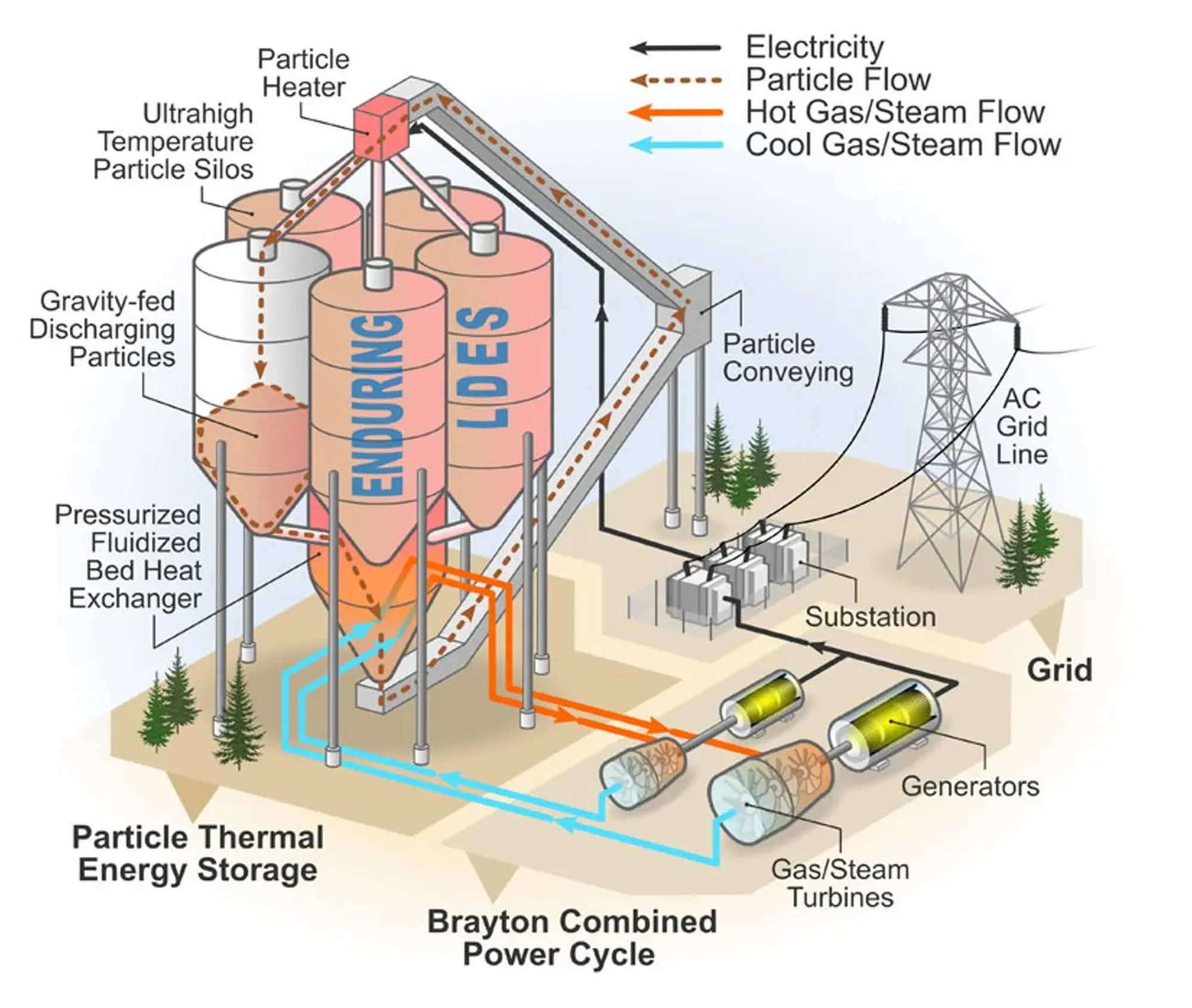
Image of what this would look like with the outcome of producing electricity.
When energy is needed, the hot particles are fed through a heat exchanger. Heat exchanger is a device used to transfer thermal energy without the 2 fluids mixing. Here you have sand and another fluid that would be exchanging heat. Although individual grains of sand are solid, when you get a lot of them, they behave like a fluid. Heat exchanged works on the principle that thermal energy is always transferred from hot to cold. The sand would lose thermal energy and transfer it to the other fluid. For the case of polar night energy the other fluid will be water (since that is what requires most heat in a home), for the case of pyrolysis I still don’t know which fluid would be required. Once the sand is discharged, cold particles are once again fed into insulated silos for storage until conditions appropriate again for charging.
The image above is a schematic by National Renewable Energy Laboratory (NREL) of a sand battery that work as mentioned above. The addition is once the sand has transferred its energy to another fluid it the heat is pressurized into a working gas inside to drive the turbomachinery and spin generators that create electricity for the grid. For pyrolysis, you would need heat not electricity as your output so your process would be different. I will be learning more about how to do that in future updates.
It is mentioned the system designed by NREL have no particular siting constraints and can be located anywhere in the country. These systems may also be constructed using existing infrastructure from retired coal- and gas-fired power plants. The baseline system is designed for economical storage of up to 26,000 MWh of thermal energy. With modular design, storage capacity can be scaled up or down with relative ease.
The main point is the heat can be stored in the sand can will be used to heat up the pyrolysis and the Fischer-Tropsch process (which turns syngas into diseal) removing any operational cost. Your cost comes from the capex of solar panels and and sand battery structure.
What Are The Economics of Algae with Drying and Pyrolysis?
My cost of algae is only $0.12 per dry kg of algae or $120/ton. For the industrial processes there is no opex cost because of your thermal storage with sand and renewable energy. Making that also cost $0.
With revenue of $991 and a cost of $120 per 1000kg of dried algae you have about a 87% margin. Of course this is not final, I would need to test growing algae in the lab with dewatering and drying to validate the cost of $120/ton and talking to customers to verify the $991/ton revenue. I also did not count any of the capital cost payments required for the machine.